

Tattoos serve as visual landmarks of personal expression milestones that occasionally lose their relevance as our lives evolve. Whether it is an outdated design, a remnant of your youth, or oversaturated cosmetic microblading requiring a clean slate, the decision to remove a tattoo is a highly common and empowering choice. When embarking on a skin transformation journey, most individuals naturally seek out clinical before-and-after progressions. However, browsing an uncontextualized photo gallery can set inaccurate expectations. A true before-and-after trajectory is fundamentally dictated by a complex chemical variable: the molecular composition and colour of the ink embedded in your skin. At Winter Park Tattoo Removal, a specialized laser tattoo removal clinic in Florida with 4.9 stars from 250+ Google reviews, we view tattoos through an advanced dermatological lens. The clearance protocol for a solid, dark black tattoo is entirely distinct from the physiological journey of a vibrant, multi coloured piece. Understanding these differences ensures a clear roadmap toward restoring your skin to a fresh, clean canvas.
The Underlying Science: How Lasers “Erase” Ink
To understand the difference between ink behaviours, it is crucial to dismantle a persistent misconception: the laser does not burn, vaporize, or scrape the pigment out of your skin. Instead, successful laser tattoo removal relies on a biological synergy between advanced light physics and your body’s natural cellular waste-clearance mechanisms.
The Photothermal and Photomechanical Impact
When a tattoo artist deposits ink into the dermis, the pigment particles are too large for your immune system’s white blood cells to engulf and eliminate. This structural size is what makes the design permanent. Modern, medical-grade laser systems resolve this by emitting ultra-short, high-energy pulses of light into the tissue.
- Selective Absorption: The pigment particles within the skin selectively absorb specific wavelengths of light energy produced by the laser.
- Acoustic Fragmentation: This sudden influx of intense energy generates a photomechanical shockwave, shattering the dense ink particles into microscopic fragments.
- Phagocytosis & Lymphatic Clearance: Once the ink is reduced to cellular dust, your body’s immune system specifically macrophages can finally engulf these fragments. Over the following weeks, the lymphatic system naturally flushes the ink out of your body.
[Intact Large Ink Particles]
│
▼
(Laser Pulse Energy)
[Shattered Micro-Fragments]
│
▼
(Lymphatic System Transport)
[Naturally Cleared Skin]
Because this process depends entirely on the ink’s ability to absorb light, the colour of that ink changes the entire operational framework of the laser.
Dark Ink Tattoo Removal: The Gold Standard of Predictability
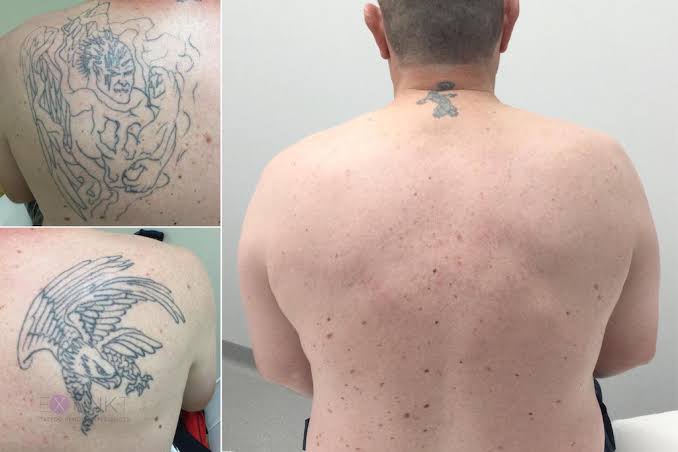
When evaluating dark ink tattoos, we are primarily referring to black, deep indigo, and charcoal grey tones. If your before-and-after goals involve a purely black or grey-wash piece, you are working with the most predictable variables in the laser industry.
Why Black Ink Absorbs Energy So Efficiently
In basic physics, black surfaces absorb all wavelengths of light and convert them into heat energy. This property makes black ink exceptionally receptive to laser energy. A standard $1064\text{ nm}$ laser wavelength passes cleanly through the upper layers of the epidermis without being intercepted by your skin’s natural melanin, striking the dark tattoo pigment directly. Because the target absorbs the energy so aggressively, the fragmentation process is highly efficient from session one. At Winter Park Tattoo Removal, our advanced technology utilizes this fundamental property to deliver optimized results on dark inks with minimized risk to the surrounding tissue.
The Before and After Timeline for Dark Ink
- Initial Sessions (1–3): You will observe immediate “frosting” during treatment a temporary white reaction caused by rapid gas release within the tissue. In the weeks that follow, bold lines will begin to soften into a charcoal hue as the crisp edges fracture.
- Mid-Way Point (Sessions 4–6): Subtle shading and lighter grey wash elements disappear entirely. Solid lines start to display structural breaks and gaps where the ink density was thinner.
- Final Stages (Sessions 7+): The remaining deeply embedded dark ink patches fade into faint silhouettes before resolving completely into natural skin tones.
Skin Tone Highlight: Because the $1064\text{ nm}$ wavelength bypasses surface melanin so cleanly, solid black ink can be safely and effectively removed across virtually all skin types including Fitzpatrick skin tones V and VI with minimal risk of hypopigmentation (loss of skin colour).
Colour Tattoo Removal: A Complex Spectrum of Light
If your tattoo features a vivid palette such as reds, blues, greens, yellows, or neon tints your before-and-after progression will follow a more intricate path. Removing multi-coloured tattoos requires an advanced understanding of colour theory and a laser system capable of deploying multiple distinct wavelengths.
Ink Colour Target Laser Wavelength Relative Removal Difficulty
────────────────────────────────────────────────────────────────────────
Black / Dark 1064 nm ★☆☆☆☆ (Easiest)
Red / Orange 532 nm ★★☆☆☆ (Moderate)
Dark Blue 650 nm / 1064 nm ★★★☆☆ (Moderate to Hard)
Green / Sky 650 nm ★★★★☆ (Hard)
Yellow / Neon Specialized / Custom ★★★★★ (Most Challenging)
The Multi-Wavelength Challenge
A single laser wavelength cannot treat a rainbow tattoo. Light must be precisely matched to the inverse colour of the pigment to ensure energy absorption rather than reflection.
- Reds, Oranges, and Earth Tones: These pigments respond remarkably well to a shorter $532\text{ nm}$ wavelength. The light energy is rapidly absorbed by the red pigment, often showing dramatic fading early in the process.
- Blues and Greens: These are notoriously stubborn colours. They reflect standard wavelengths and require specialized settings, such as a dedicated $650\text{ nm}$ wavelength, to properly break down the stubborn ink matrix.
- Yellows, Whites, and Fluorescents: Yellow and white pigments are among the most difficult to clear because they reflect almost all visible light. White ink also carries a risk of permanent paradoxical darkening, where the titanium dioxide in the ink oxidizes under the laser and turns a dark grey or black during the initial pass.
The Before and After Timeline for Colour Inks
Because different colours shatter at different rates, a multi-coloured tattoo will fade unevenly. For example, a red and black tattoo may see the red components completely clear by session four, while the dense black lines require a few more visits. Your mid-process “after” photos might look patchy as individual pigments exit the skin at varying speeds. This is why our tailored protocols at Winter Park Tattoo Removal integrate multi-wavelength capabilities to handle colour anomalies sequentially and effectively.
Direct Comparison: Dark Ink vs. Colour Tattoos
To help you accurately map out your expectations, let’s look at how these two categories match up across critical treatment metrics:
| Operational Metric | Dark Ink Tattoos (Black/Grey) | Colour Tattoos (Multi-Coloured Pieces) |
| Laser Settings | Typically requires a single wavelength ($1064\text{ nm}$) across treatments. | Requires multiple wavelengths switched mid-session or across appointments. |
| Session Count | Generally fewer sessions required for standard, non-layered pieces. | Often requires an extended protocol due to varying pigment clearance rates. |
| Fading Consistency | Fades uniformly from black to grey, then gradually disappears. | Fades unevenly; some colours vanish rapidly while others persist. |
| Skin Tone Compatibility | Highly compatible across all skin shades when using the proper wavelength. | Treating bright colours on deeper skin tones requires specialized settings to protect surface melanin. |
| Cover-Up Readiness | Lightens easily to a clean canvas for cover-ups or revisions. | Can leave behind faint blue/green hues that require strategic cover designs. |
Critical Factors Influencing Your Before & After Results
While ink colour is a massive variable, your body is an active participant in the removal process. Several other elements determine the speed and success of your clearance journey:
1. Cellular Circulation and Proximity to the Heart
Because your lymphatic system removes the shattered ink fragments, blood circulation is a major factor. Tattoos located closer to your heart (such as on the neck, chest, or upper arms) typically clear faster than tattoos located on peripheral areas with slower circulation, like the lower legs, ankles, fingers, or toes.
2. Ink Density and Layering
Professional tattoos feature a high density of ink deposited deep within the dermis, which requires more fragmentation cycles than amateur tattoos, which are often shallow and uneven. Furthermore, if you have a cover-up tattoo, you effectively have double the volume of ink trapped in the same tissue space, naturally extending your timeline.
3. The Power of Your Laser System
Not all laser systems deliver the same clinical results. Standard, low-powered systems often struggle to generate enough energy to shatter deeply embedded or stubborn coloured pigments, leading to plateaus where the tattoo stops fading. At Winter Park Tattoo Removal, we combat this by utilizing a high-powered 2-Joule Laser Removal System. This specialized equipment delivers the high mechanical force necessary to fracture resilient ink matrices while carefully safeguarding the surrounding skin tissue.
What to Expect During the Removal Process
Understanding the steps of a laser session can help alleviate any anxiety about the process. Here is how a standard treatment unfolds at our clinic:
Critical Aftercare for Flawless Before & After Outcomes
The care you provide your skin between sessions is just as important as the laser treatment itself. Proper aftercare ensures efficient ink elimination and helps prevent complications.
- Keep it Clean and Dry: For the first 24 to 48 hours, treat the area with care. Wash it gently with a mild, unscented soap and pat it completely dry.
- Do Not Disturb the Skin: It is common for the area to develop minor scabs or superficial blisters. Never pick, scratch, or pop them. Doing so can interrupt the natural healing process and introduce a risk of scarring.
- Practice Consistent Sun Protection: Sun exposure increases melanin activity, which can complicate your next session. Keep the area covered or apply a high-quality broad-spectrum sunscreen whenever you are outdoors.
- Maintain Scheduled Intervals: Sessions must be spaced 6 to 8 weeks apart. Giving your body adequate time between treatments allows your skin to fully recover and gives your immune system a clear window to flush away the shattered ink particles.
Why Choose Winter Park Tattoo Removal?
Your skin is a permanent asset, and removing ink requires specialized clinical expertise. Here are several reasons patients choose Winter Park Tattoo Removal:
- Over 20 Years of Proven Experience: Serving the community since 2004, we are an established tattoo removal practice in Winter Park, with 4.9 stars from 250+ Google reviews.
- Advanced Multi-Wavelength Systems: We utilize advanced laser technologies featuring premium 2-Joule high-power configurations delivering the specific energy levels required to treat stubborn pigments effectively.
- Medical Oversight and Expertise: All procedures are administered by fully licensed, experienced personnel and supervised by board-certified physicians, with high standards of safety, cleanliness, and clinical care.
- Comprehensive Specialty Services: Beyond standard body art, we provide specialized removal options for faded cosmetic microblading, scalp micropigmentation corrections, and targeted fading for cover-ups.
Ready to Start Your Skin Transformation?
Whether you are looking to completely erase an old tattoo or fade an existing piece to prepare for a clean cover-up design, our team is here to help you move forward with confidence. We invite you to reach out to our specialists today to schedule your comprehensive, free initial evaluation. We will analyse your ink type, outline a clear expectation for your personal before-and-after journey, and design a treatment plan built around your unique goals.