

Quick answer:
Most tattoos are removed with a laser. Very short pulses of light break the ink into tiny particles, and your immune system clears them over the following weeks. Most tattoos need several sessions spaced 6–8 weeks apart. Surgical excision can remove a very small tattoo in one visit but always leaves a scar. Dermabrasion, saline removal and creams are less predictable, and no tattoo removal cream is FDA-approved. Results depend on ink color, tattoo age, location and skin type.
Key takeaways
- Laser removal works on most tattoos, sizes, ink colors and skin types.
- Cutting a tattoo out (excision) is fast but trades the tattoo for a scar.
- No tattoo removal cream is FDA-approved, and DIY methods can burn or scar the skin.
- Results depend on ink color, depth, tattoo age, where it is on the body, and your skin type.
Why are tattoos so hard to remove?
Tattoo ink is placed in the dermis, the layer of skin under the surface. Your immune system sends cells to clean up the ink, but most ink particles are too large for them to break down. Those cells hold onto the ink instead, and when they die, new cells take it up again. This cycle is why a tattoo stays put for decades. To remove one, a treatment has to either break the ink into particles small enough for the body to carry away, or remove the skin that holds it
What are the different ways to remove a tattoo?
| Method | How it works | Best for | Visits needed | Scarring risk | Typical healing |
| Laser removal (picosecond or Q-switched) | Light pulses break ink into tiny particles the body clears | Most tattoos, any size | Several, 6–8 weeks apart | Low with a trained provider | Redness, swelling, possible blisters; skin surface heals in about 1–2 weeks |
| Surgical excision | Tattooed skin is cut out and stitched closed | Very small tattoos | Usually 1 (larger ones in stages) | Certain (a line scar) | Stitches out in about 1–2 weeks; scar softens over months |
| Dermabrasion | Top layers of skin are sanded away | Rarely recommended today | 1 or more | High | Raw skin for about 10–14 days; redness can last weeks |
| Saline (non-laser) removal | Salt solution is worked into the skin to draw ink up into a scab | Small or cosmetic tattoos; partial lightening | Several | Moderate | Scabs form and fall off over a few weeks |
| Creams and DIY methods | Acids or bleaching agents act on the surface | Not recommended | — | Burns, scarring, discoloration | — |
| At-home lasers and pens | Consumer devices | Not recommended | — | Burns, scarring, eye injury | — |
Want more detail on one method? See Can You Cut Out a Tattoo? Surgical Excision vs. Laser, Saline vs. Laser Tattoo Removal and Laser vs. Cream.
How does laser tattoo removal work?
- The laser fires extremely short pulses, lasting billionths (nanosecond) or trillionths (picosecond) of a second, at a wavelength the ink absorbs.
- The ink heats and shatters into tiny fragments. The surrounding skin absorbs far less of that energy.
- A white “frost” appears on the treated skin for a few minutes. This is normal.
- Your lymphatic system carries the fragments away over the next several weeks, so the tattoo keeps fading between sessions. (
Different wavelengths target different colors:
- 1064 nm: black and dark blue. It’s also the safest wavelength for darker skin tones.
- 532 nm: red, orange and yellow.
- 755–785 nm and 694 nm: green and light blue, usually the hardest colors.
- Picosecond vs. Q-switched: picosecond lasers deliver shorter pulses that break ink into finer particles. Studies have found they often clear ink in fewer sessions than older Q-switched lasers, especially stubborn colors. At our Winter Park clinic we use [laser model].
- Ways to get more from each session: the PFD patch lets the provider make several laser passes in one visit. If you only want a tattoo lightened for a cover-up, laser fading takes fewer sessions than full removal.
Which tattoo removal method is best?
For most people, laser removal is the best option. It treats tattoos of any size, has the lowest scarring risk of any method that actually works, and gets results on most ink colors.
- Choose a laser if you want the tattoo gone or lightened with minimal scarring.
- Consider excision if the tattoo is very small, you want it gone in one visit, and you’re comfortable with a scar.
- Ask about non-laser options if the tattoo has white, pink, flesh-toned or some cosmetic inks. These can darken when treated with a laser, so a provider should test-spot them first.
- Avoid creams, salt scrubs, acids and at-home devices.
How long does healing take with each method?
- Laser: redness and swelling for 1–2 days, possible blisters in the first week, then light scabbing or flaking. The surface usually heals in 1–2 weeks while the ink keeps fading for 6–8 weeks.
- Excision: stitches for about 1–2 weeks; the scar matures over several months.
- Dermabrasion: raw, weeping skin for about 10–14 days, with pinkness that can last weeks.
- Saline: a scab forms over the treated area and falls off on its own over a few weeks.
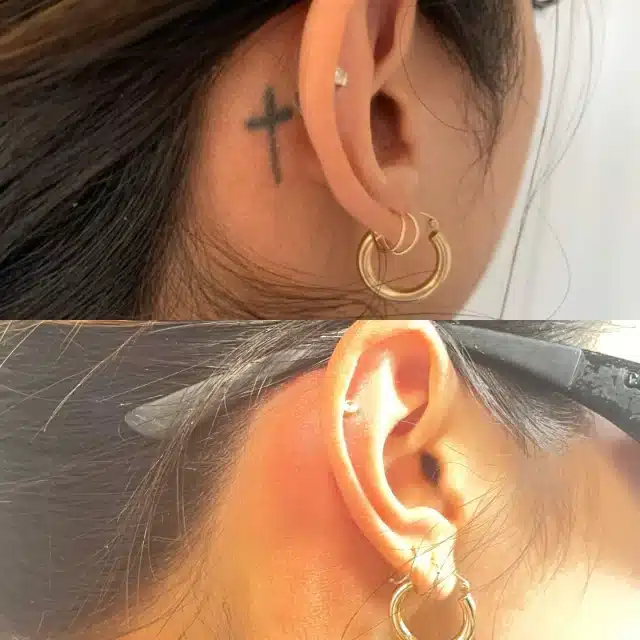
How many laser sessions will I need?
Most tattoos need multiple sessions, often somewhere between 5 and 12. The number depends on ink color, how dense the ink is, the tattoo’s age and location, and your skin type. Many clinics estimate it with the Kirby-Desai scale. Sessions are usually spaced 6–8 weeks apart so your body can clear the broken-up ink.
Does tattoo removal hurt?
Most people describe laser treatment as feeling like a rubber band snapping against the skin. Each session lasts only minutes. Numbing options include a topical BLT numbing cream or lidocaine given by a licensed provider.
Is laser tattoo removal safe? Side effects to know
Laser removal is considered safe when a trained, licensed provider does it. Common, temporary effects are redness, swelling, blistering and scabbing. Less common effects are lighter or darker patches of skin, scarring, and darkening of white or flesh-toned inks. Allergic reactions are rare. Darker skin can be treated safely with the right wavelength and settings.
Can every tattoo be completely removed?
Many tattoos clear fully or almost fully. Some leave a faint “ghost,” especially tattoos with heavy layers of ink or green and light-blue ink. A consultation is the only way to get a realistic estimate for your tattoo.
Tattoo removal methods to avoid
- Removal creams: the FDA has not approved any do-it-yourself tattoo removal creams, and the acids in them can burn the skin. (Do Tattoo Removal Creams Work?)
- Salt scrubbing (salabrasion), lemon juice and DIY acid peels: these damage the skin long before they reach the ink.
- At-home lasers and pens: they don’t have the power to remove ink, and they can still burn the skin. (At-Home Tattoo Removal Devices)
- Untrained or unsupervised providers: laser tattoo removal should only be done by trained staff under medical oversight.
Laser tattoo removal in Winter Park & Orlando
At Winter Park Tattoo Removal (610 N Wymore Rd, Suite A, Winter Park, FL 32789), each plan starts with a free assessment of your tattoo’s colors, size and skin type, followed by a written session estimate. We serve Winter Park, Orlando, Maitland, Altamonte Springs and nearby areas.
Frequently asked questions
1: What is the most effective way to remove a tattoo?
Laser removal is the most effective method for most tattoos. Light pulses break the ink into particles your body clears naturally. It takes several sessions, but it has the lowest scarring risk of any method that reliably works.
2: Can a tattoo be removed in one session?
Rarely by laser. Most tattoos need several sessions spaced 6–8 weeks apart. Surgical excision can remove a very small tattoo in one procedure, but it leaves a permanent scar.
3: Is it better to cut out a tattoo or laser it?
Laser is better for most tattoos because it avoids a surgical scar. Excision only makes sense for very small tattoos when you want them gone at once and accept a line scar.
4: Do tattoo removal creams work?
No. Creams act on the surface of the skin and can’t reach ink in the dermis. None are FDA-approved for tattoo removal, and some cause chemical burns or scarring.
5: How soon after getting a tattoo can I start removal?
Wait until the tattoo is fully healed, usually at least 6–8 weeks. Many providers prefer a few months.
6: Does laser tattoo removal leave a scar?
Scarring is uncommon when a trained provider uses the right settings and you follow aftercare. Picking at blisters or scabs and sun exposure raise the risk.
7: Which tattoo colors are hardest to remove?
Black and dark blue respond best. Green, light blue, yellow, and white or flesh-toned inks are the hardest and may need more sessions or a different wavelength.
8: How much does tattoo removal cost?
It depends on the tattoo’s size and how many sessions it needs. See our laser tattoo removal cost page for current Winter Park pricing and payment plans.
Want Winter Park Tattoo Removal's guides and news to show up first when you search Google?